
By Matthew Brown
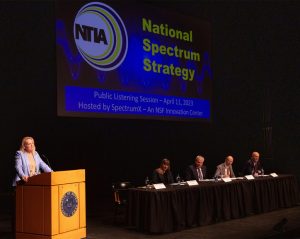 In recent years, U.S. policymakers’ attempts to balance spectrum uses have become increasingly contentious. Disputes between GPS, aviation, weather forecasting, broadcasting, and mobile broadband have taken place across the regulatory, legislative, and commercial landscape. As the airwaves become more crowded and public disagreements over uses play out in the national media, calls for a more measured and deliberate approach to management of the airwaves have arisen. While this situation has unfolded domestically, allies and adversaries abroad have continued to develop their own spectrum landscape. Regardless of the course of US telecommunications policy, China and other nations will continue to develop their own spectrum resources, wireless infrastructure, and space capabilities. It is against this backdrop that NTIA has begun drafting a National Spectrum Strategy (NSS), intended to maximize use of scarce spectrum resources, facilitate continued U.S. leadership in wireless technology, and update the entire federal government’s approach to spectrum.
As a first step, NTIA published a request for comment (RFC) seeking public input, highlighting its desire to build a strategy “based upon collaboration with both federal and non-federal stakeholders, including Tribes, and on data-driven decision-making, to fully address the needs of spectrum reliant services and missions.” The RFC received over 130 public comments across a broad range of stakeholders. NTIA also hosted multiple listening sessions and offered opportunities for one-on-one meetings. Formal feedback processes are largely finished. With drafting underway, NTIA now has the tough task ahead to balance needs across vital sectors of the economy and government to support the United States’ technology leadership.
What Is the National Spectrum Strategy?
According to the RFC, the NSS is an effort to guide government action “to accelerate U.S. leadership in wireless communications and other spectrum-based technologies and to unlock innovations that benefit the American people.” The NSS and ensuing implementation plan will seek to ensure that both federal and non-federal spectrum users have the resources necessary to maintain and grow national security, public safety, next-generation communications, and scientific discovery. At the first public listening session on the NSS, NTIA Administrator Alan Davidson explained that the NSS aims to “build a spectrum pipeline that will meet the short-, medium-, and long-term needs of both commercial and federal users.” At the same listening session, NSS Director Scott Blake Harris said that “mid-November is our deadline for coming out with our spectrum strategy.” This coincides with the start of the World Radiocommunication Conference 2023 in Dubai (WRC-23), helping the US delegation and its international partners clearly communicate America’s spectrum priorities.
NTIA has identified three pillars for the NSS, focusing on (i) a spectrum pipeline, which would directly identify 1,500 megahertz of new spectrum for “in-depth study to determine whether that spectrum can be repurposed to allow more intensive use” (i.e., spectrum identified for study will not necessarily be repurposed or subject to new sharing arrangements); (ii) long-term spectrum planning and coordination; and (iii) research and innovative technologies to improve spectrum access.
What Is Driving the Need for an NSS?
Today, many prime bands of spectrum – particularly so-called ‘beachfront’ mid-band spectrum – are fully occupied by federal and commercial users. The sentiment that ‘there is no greenfield spectrum left’ came up often in NSS comments and listening sessions. With the growth of 5G (and likely 6G) bandwidth requirements, the wireless industry seeks more spectrum to build faster and more ubiquitous networks. Simultaneously, other commercial sectors are experiencing increased spectrum demands – including unmanned aircraft systems (UAS), high-speed global satellite constellations, and emerging commercial space endeavors. This growing commercial need for spectrum collides with ongoing federal uses for spectrum for defense, public safety, weather monitoring, and other critical missions. While federal users have begun exploring how commercial wireless technologies such as 5G can support their missions, their own future demands for spectrum are also growing, and cannot be met solely by commercial partnerships. Admiral Christopher Grady, vice chairman for the Joint Chiefs of Staff, said in 2021 that “[e]lectromagnetic spectrum superiority is of critical importance to the national security of the nation. To ensure superiority, we must have an integrated approach to governance that effectively prioritizes EMS through DOD requirements, resourcing, workforce, and operations.”
Bands in Play
Though long-term questions about spectrum management are important, spectrum stakeholders will be more interested in the bands which will ultimately be identified for in-depth study for potential repurposing. In the RFC comments, stakeholders identified large sections of mid-band spectrum for potential repurposing – including the 3-8 GHz and 7-15 GHz ranges. More specifically, the 3.1-3.45 GHz and 4.4-4.9 GHz bands were referenced frequently. Stakeholders also raised the 7.125-8.4 GHz band, discussing potential expansion of either licensed or unlicensed use therein.
Some commenters highlighted the sharing approach employed in the CBRS band as a model to be extended to adjacent or other bands, while others, particularly wireless advocates such as CTIA, criticized it as a failure. Several commenters also expressed support for NTIA’s Incumbent Informing Capability (IIC) concept to increase spectrum sharing opportunities with federal systems. Sharing advocates, such as the Dynamic Spectrum Alliance (DSA) and Federated Wireless, referenced successes in CBRS and the 6 GHz band as models for future tiered-use sharing arrangements. Federated Wireless, for example, recommends considering the 37.0-37.6 GHz, 7.125-8.4 GHz, and 4.4-4.95 GHz bands.
The NSS comments also reflected long-term industry battles over licensed and unlicensed use. Wireless advocates predictably suggested opening more full-power, licensed spectrum in the mid band. CTIA and T-Mobile mentioned the 3.1-3.45 GHz, 4.4-4.94 GHz, and 7.125-8.4 GHz bands. The Competitive Carriers Association added the 450 MHz and 3.98-4.2 GHz bands, and additional bands up to the 16 GHz range. 5G Americas suggested numerous low- and high-frequency bands. The wireless industry generates significant GDP and auction revenues, ensuring that regulators will pay close attention to these requests.
While the mobile network operators want more licensed, full-power spectrum, wi-fi advocates argue for expanding unlicensed use. Wi-Fi Alliance, for example, recommends extending unlicensed allocations above 7.125 GHz and supports innovative spectrum sharing techniques. Advocates for unlicensed spectrum argue that most American data is transferred through wi-fi at home and at work rather than via cellular networks.
However, these familiar commercial debates in the RFC process should not obscure important developments happening elsewhere. Federal users have embraced new technologies to improve their spectrum efficiency. Tribal and municipal users have started using unlicensed spectrum and embracing the CBRS model. Academics described new interference mitigation technologies which promise to make dynamic spectrum sharing more feasible and reliable. Many commenters, like the Aspen Institute, called for the rationalization of spectrum management bureaucracy. While some commenters offered unlikely spectrum management solutions requiring significant congressional and presidential willpower, SpectrumX’s Nick Laneman proposed a plan to create a National Coordination Office (NCO) in the White House which could coordinate R&D and workforce development activities.
With these different perspectives in mind, the three pillars of the NSS highlight different directions that NTIA could take. The first pillar indicates that the NSS will focus significantly on identifying spectrum for study. This much is almost certain. However, the second and third pillars offer options for longer term and potentially highly significant changes to spectrum management. For now, we will have to wait and see the direction NTIA decides to take given the feedback it has received.
Conclusion
The NSS represents an exciting opportunity for NTIA and the future of spectrum management in the United States. With an assortment of comments to review, NTIA will have to walk a fine line to develop a balanced strategy reflecting a variety of federal and non-federal interests. All of this is happening amid an unprecedented lapse in FCC auction authority and the approaching WRC-23. In an uncertain regulatory environment, the NSS promises to offer much-needed clarity about the future of spectrum management.
The views and opinions expressed in this blog post are those of the writer and do not necessarily reflect the views or positions of any entities they represent.